Press play. In three minutes, see the calm, no-hype plan that gets an ordinary family through a blackout — warm, fed and watered, with no generator and no bunker.
You'll meet a lot of methods in this book, but underneath all of them are only five ideas. If you forget everything else, keep these — with them you could work out most of this book on your own.
Everybody plans the gap between "the lights went out" and "the lights came back on." That's the wrong frame. Plan for what's happening to your food, your warmth and your water during that gap, and you'll make completely different — and far cheaper — decisions.
Never buy a piece of gear until you understand the problem it solves. Half the money wasted in preparedness is spent solving a problem the person never actually had. Understanding is free, and it's what tells you when the sixty-dollar answer beats the six-hundred-dollar one.
Frozen water jugs, a wool blanket, a five-gallon bucket, a bag of rice. The unglamorous stuff carries a family through an outage far better than the shiny gadget. If a plan depends on one expensive device working perfectly, it's a fragile plan.
Two small ways to boil water beat one big generator. Anything can fail, so never let your family's safety hang on a single thing. Layer cheap, simple backups and you're never one breakdown away from trouble.
No amount of comfort is worth carbon monoxide, a house fire, or bad water. The fastest way to turn an inconvenience into a tragedy is an unsafe shortcut for heat, light or cooking. When in doubt, choose the safe option — even if it's colder or slower.
Every chapter takes one problem and does the same five things with it: what's actually happening, why the usual approach fails, the exact method, the small habit that keeps you ready — and what it honestly costs. You don't have to read it in order.
“You don't need a bunker. You need a plan, a little cheap gear, and to understand why it works.”
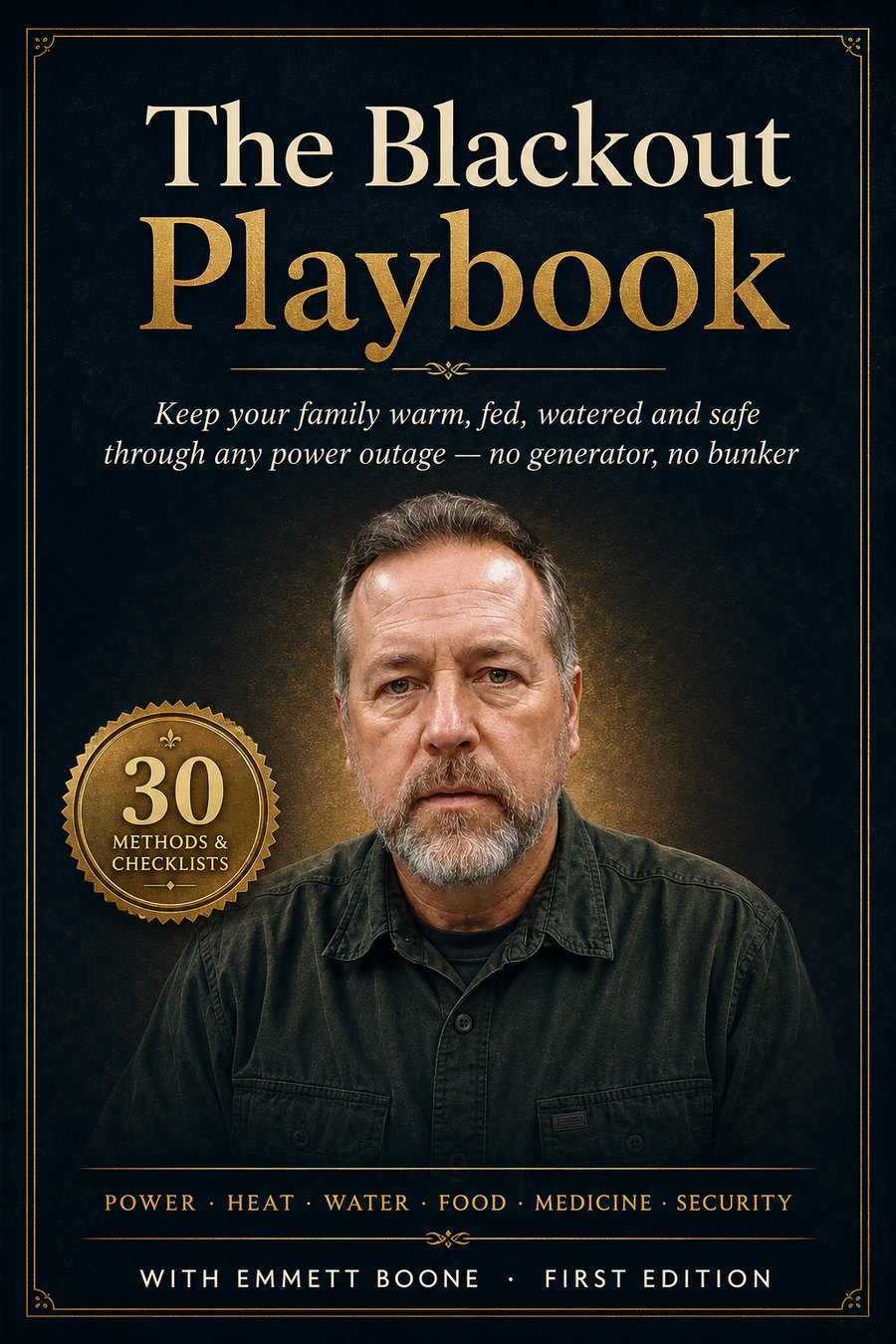
All 353 illustrated pages plus every appendix that makes it work on day one — nothing sold separately, nothing held back for a "premium version."
Each line is small on its own. Together they're the difference between an outage that quietly empties your wallet and one your family barely notices.
| What an outage takes | Because now you… | |
|---|---|---|
| A freezer of food, carried to the curb on day three | → | Keep it cold for days on about $300 of setup |
| A $900 generator you run twice and store wrong | → | Know exactly how many watts you actually need |
| Hotel nights because the house got too cold | → | Turn one room into a thermos for under $30 |
| Cases of bottled water at emergency prices | → | Store it right and make questionable water safe |
| Spoiled insulin or a missed device | → | Have the cold-chain and power plan written down |
| Gear bought in a panic, at panic prices | → | Buy in the right order, one item a payday |
| The part nobody prices: three days of fear | → | Open the book, and know what to do first |
The book costs $37, once. The next outage doesn't care whether you read it.
Pieces of it, yes — scattered across a thousand videos, half of them selling you something and a few of them dangerously wrong. What you're paying for is the order: what matters first, what's a waste of money, and what will hurt you. I've been through five extended outages and written down what actually failed each time. That's the part you can't get from a search bar at 2am with no power.
Yes, and more of it than you'd think. Food, water, light, warmth, medicine, sanitation and communication don't care whether you own the building. Chapters that need a yard or a garage are marked, and there's an apartment-friendly path through the whole plan — including what to do when you can't store fuel or run anything that burns.
Probably the two things most people are missing: running that generator without poisoning your family, and knowing whether your supplies actually match your household's real numbers. Most people own gear they've never tested and can't say how many days it buys them. This book turns a pile of stuff into a plan.
Neither. No bunkers, no collapse fantasies, no politics. This is for ice storms, hurricanes, heat waves and an aging grid — the outages that already happen every year. If anything, it argues against the fear that gets sold to you at a markup.
Nothing to start. The first tier is $0 and takes one week — it's things you already own, put in the right place. The essentials tier is about $300 spread over a few months, in a buying order the book gives you, cheapest life-saving item first. Everything past that is comfort, and it's clearly labeled as optional.
Good, because this isn't one. Do one thing this week, then come back. The whole book is built to become a handful of small habits and one page on your fridge — not a hobby.
Nothing here needs wiring, an electrician, or a hole in your wall. The core setup is a chest freezer, some frozen water jugs and a small battery. Every method is plain language with a diagram, and anything that genuinely needs a professional, I tell you to hire one.
It's written for a normal North American household, and the prices and radio bands reflect that. The physics — how cold moves, how water gets safe, what a watt does — work anywhere. If you live outside the US, everything still applies except the specific licence and station details.
An illustrated PDF, delivered the moment you check out on Gumroad. It opens on your phone, tablet or computer, and the reference sheets are designed to be printed and stuck on the fridge — which matters, because the day you need them the screen may be dead.
Write to us within 7 days and you get a full refund, no questions and no hard feelings — and you keep the book. I'd rather you be ready than out $37.
You can meet it with a plan, a little cheap gear, and the calm that comes from knowing exactly what to do first.
Get the playbook — $37 →